Self Publishing vs Traditional Publishing: Shocking Truth
Introduction: The Biggest Publishing Decision Authors Face
Choosing between self publishing vs traditional publishing is one of the most critical decisions an author will ever make. Many writers assume that traditional publishing is the only path to success, while others believe self publishing is quick and easy money.
The truth is far more complex—and often shocking.
Each publishing model has its own rules, risks, rewards, and long-term impact on your career. Making the wrong choice can cost you years of effort, lost royalties, or complete creative burnout.
This guide breaks down the real differences, step by step, so you can confidently choose the publishing path that aligns with your goals, budget, and vision.
Understanding the Basics of Publishing Models
Before comparing outcomes, it is important to understand how each model works at its core.
What Is Traditional Publishing?
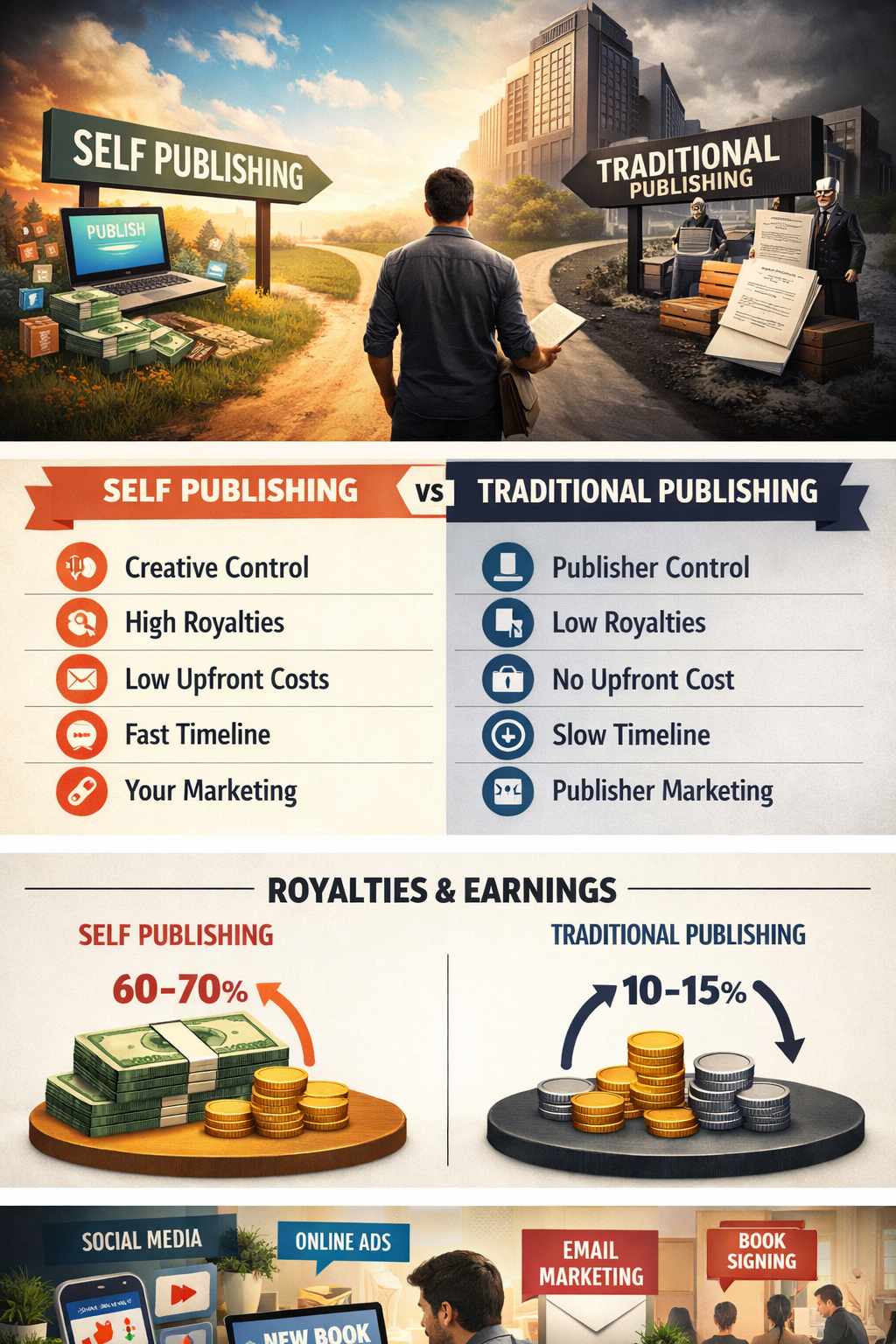
Traditional publishing involves submitting your manuscript to a publishing house. If accepted, the publisher handles editing, design, printing, distribution, and marketing.
However, the author gives up significant control in exchange for these services.
Key features:
-
Publisher owns most rights
-
Long approval timelines
-
Lower royalty percentages
-
No upfront cost (in most cases)
What Is Self Publishing?
Self publishing allows authors to publish their books independently. The author controls every stage of the process, either by managing it personally or hiring professionals.
This model gives freedom—but also responsibility.
Key features:
-
Full creative control
-
Higher royalty rates
-
Faster publishing timeline
-
Author pays initial costs
Self Publishing vs Traditional Publishing: Step-by-Step Comparison
Let us break down the differences across the most important factors.
1. Control and Creative Freedom
Traditional Publishing Reality
In traditional publishing, the publisher decides:
-
Book title
-
Cover design
-
Pricing
-
Editing style
-
Marketing strategy
Authors often have little to no final say.
Many writers are shocked to learn that even the book cover may not reflect their vision.
Self Publishing Advantage
With self publishing:
-
You approve every detail
-
Your vision stays intact
-
You choose your audience and brand
For authors who value creative ownership, self publishing offers unmatched freedom.
2. Publishing Timeline
Traditional Publishing Timeline
The traditional route is slow.
Typical timeline:
-
Query agents (6–12 months)
-
Publisher acquisition (3–6 months)
-
Editing and production (9–18 months)
Total time: 1.5 to 3 years
Self Publishing Timeline
Self publishing is fast.
Typical timeline:
-
Editing and formatting
-
Cover design
-
Publishing setup
Total time: 2 to 6 months
For authors who want speed and relevance, self publishing wins clearly.
3. Cost and Financial Investment
Traditional Publishing Costs
Traditional publishing usually has no upfront cost. However, this does not mean it is free.
Hidden costs include:
-
Loss of rights
-
Low royalty percentages
-
Marketing expenses often shifted to authors
Self Publishing Costs
Self publishing requires upfront investment:
-
Editing
-
Cover design
-
Formatting
-
Marketing
However, these costs are one-time and under your control.
4. Royalties and Earnings
This is where the shocking truth often surprises new authors.
Traditional Publishing Royalties
Average royalties:
-
Print books: 5–10%
-
Ebooks: 10–15%
The publisher earns most of the revenue.
Self Publishing Royalties
Average royalties:
-
Ebooks: 60–70%
-
Print books: 40–60%
Self published authors earn significantly more per book sold.
5. Marketing and Promotion Reality
Traditional Publishing Myth
Many authors believe publishers handle marketing fully. This is rarely true unless you are a celebrity or bestselling author.
Most authors are still expected to:
-
Build an audience
-
Promote on social media
-
Arrange events and interviews
Self Publishing Marketing
Self publishing requires proactive marketing, but the advantage is:
-
You control the strategy
-
You keep all profits
-
You build direct reader relationships
With the right guidance, marketing becomes a growth asset rather than a burden.
Benefits of Self Publishing vs Traditional Publishing
Both models offer benefits depending on your goals.
Benefits of Traditional Publishing
-
Industry credibility
-
Bookstore distribution potential
-
Professional production teams
-
No upfront investment
Industry credibility
Bookstore distribution potential
Professional production teams
No upfront investment
Best for authors seeking validation and prestige.
Benefits of Self Publishing
-
Full ownership and rights
-
Higher income potential
-
Faster publishing
-
Direct audience control
-
Global reach
Full ownership and rights
Higher income potential
Faster publishing
Direct audience control
Global reach
Best for authors focused on long-term growth and independence.
Best Practices for Choosing the Right Publishing Path
Before deciding between self publishing vs traditional publishing, follow these best practices.
1. Define Your Author Goals
Ask yourself:
-
Do I want creative control?
-
Is speed important?
-
Do I want passive income or prestige?
Your answers guide your choice.
2. Understand Your Budget
Self publishing requires investment, but it is scalable. Start small and grow strategically.
3. Know Your Audience
If your audience is niche or digital-first, self publishing offers better targeting and reach.
4. Think Long-Term
Publishing is not a one-time event. It is a career decision.
Common Mistakes Authors Must Avoid
Many authors fail not because of talent, but because of poor decisions.
Mistake 1: Choosing Based on Ego
Prestige alone does not guarantee success.
Mistake 2: Skipping Professional Editing
Unedited books harm credibility and sales.
Mistake 3: Ignoring Marketing
A book without marketing remains invisible.
Mistake 4: Not Understanding Contracts
Traditional contracts can lock rights for decades.
Mistake 5: Doing Everything Alone
Publishing is a business. Professional support matters.
Why Choose a Professional Publishing Company
Whether you choose self publishing or traditional publishing, working with a professional publishing company changes everything.
Professional Support Provides:
-
Expert editing and design
-
Market-ready formatting
-
Strategic book positioning
-
Distribution guidance
-
Long-term author branding
Expert editing and design
Market-ready formatting
Strategic book positioning
Distribution guidance
Long-term author branding
For self publishing authors, professional services remove confusion and reduce costly mistakes.
For traditional authors, guidance helps avoid unfair contracts and missed opportunities.
The Shocking Truth Authors Need to Accept
The real difference in self publishing vs traditional publishing is not quality—it is control, ownership, and mindset.
Traditional publishing favors publishers.
Self publishing favors authors who treat writing as a business.
Neither path guarantees success. However, informed decisions dramatically increase your chances.
Final Thoughts: Which Publishing Path Is Right for You?
There is no universal winner in self publishing vs traditional publishing. The right choice depends on your goals, timeline, and willingness to take ownership.