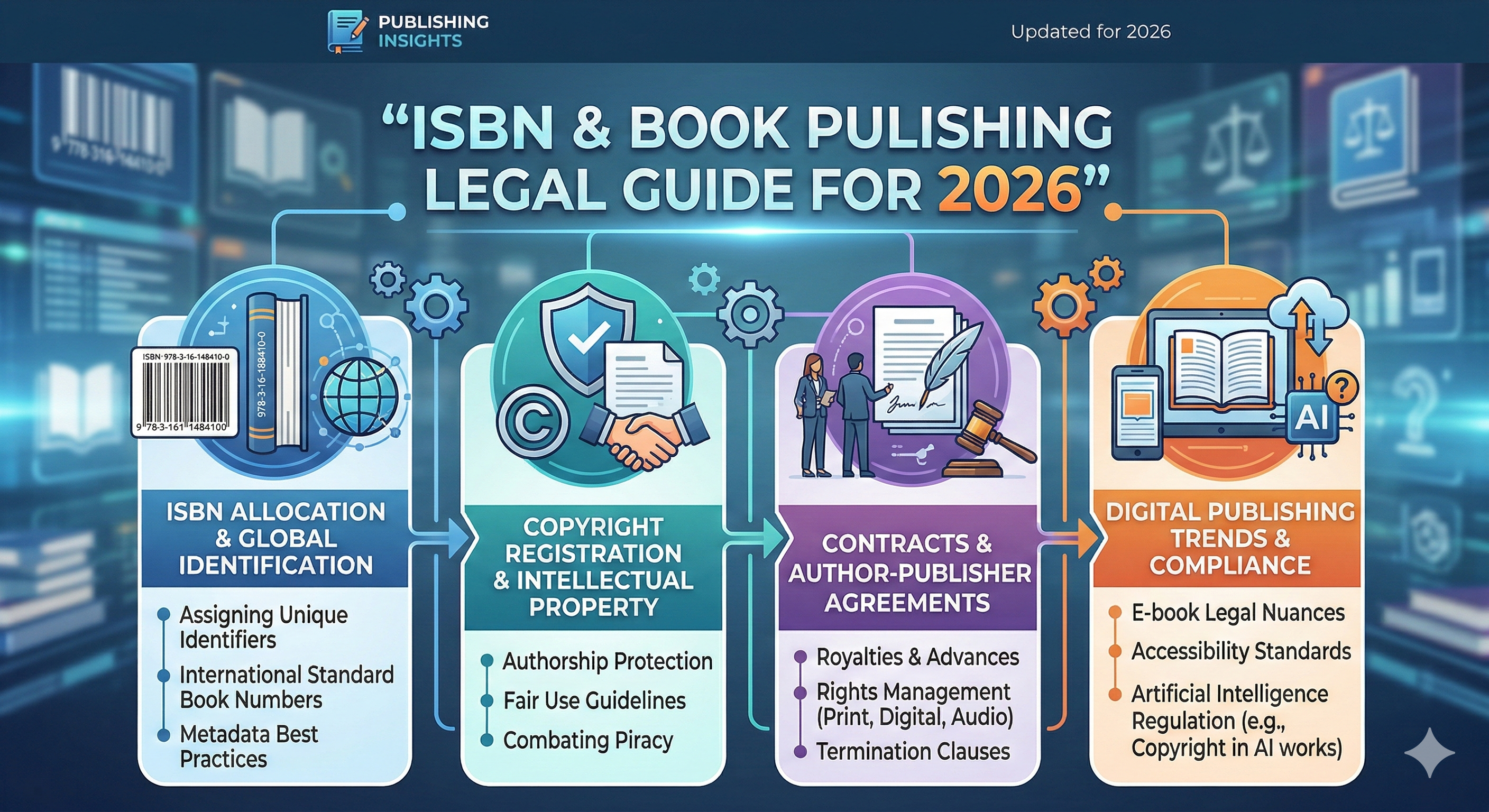
How ISBN for Book Publishing Expands Global Sales
Introduction: Why Many Books Fail to Reach Global Readers
Many authors write great books but struggle to sell them beyond their local market.
The content may be powerful. The cover may look professional. But without proper identification, bookstores, distributors, and online retailers cannot list or track the book correctly.
This is where ISBN for book publishing becomes essential.
An ISBN is not just a number printed near a barcode. It is the global identity of your book. It allows your title to be recognized, cataloged, distributed, and sold worldwide.
If you want your book to reach international readers, appear on major platforms, and be accepted by distributors, understanding ISBN is critical.
In this guide, you will learn:
-
What ISBN is
-
How it works
-
Why it increases global sales
-
Best practices for using it
-
Common mistakes to avoid
-
Why professional assistance matters
Let’s begin step by step.
What Is ISBN for Book Publishing?
ISBN stands for International Standard Book Number.
It is a unique 13-digit number assigned to a specific book edition and format.
Think of it as your book’s passport.
Just like every product in a supermarket has a barcode, every professionally published book needs an ISBN for identification and tracking.
What Does an ISBN Identify?
An ISBN identifies:
-
The book title
-
The author
-
The publisher
-
The format (paperback, hardcover, eBook)
-
The edition
Each format needs a separate ISBN.
For example:
-
Paperback → 1 ISBN
-
Hardcover → 1 ISBN
-
eBook → 1 ISBN
If you publish in multiple formats, you need multiple ISBNs.
Why ISBN for Book Publishing Is Important
Without an ISBN, your book becomes invisible in the global supply chain.
Here’s why it matters.
1. Global Recognition
Bookstores and libraries worldwide use ISBN databases to catalog books.
Without an ISBN:
-
Your book cannot be listed properly
-
Libraries cannot catalog it
-
Retailers may reject it
With ISBN for book publishing, your book becomes globally searchable.
2. Easier Distribution
Distributors require ISBNs to manage inventory.
They use the number to:
-
Track sales
-
Manage stock
-
Process returns
-
Generate reports
No ISBN means limited distribution.
3. Professional Credibility
Books with ISBNs look professional.
Readers trust books that follow publishing standards. Retailers also prefer working with properly registered titles.
4. Online Retail Platform Requirements
Major platforms like:
-
Amazon
-
Flipkart
-
Barnes & Noble
-
International bookstores
often require ISBNs for wide distribution and expanded catalog listings.
If you want global sales, ISBN for book publishing is non-negotiable.
Step-by-Step: How ISBN for Book Publishing Works
Understanding the process helps you avoid mistakes.
Step 1: Register as a Publisher
If you are self-publishing, you can:
-
Register as an independent publisher
-
Or apply through an official ISBN agency
In India, ISBNs are issued by the government agency responsible for book numbering.
Step 2: Apply for ISBN
You must submit:
-
Book title
-
Author name
-
Publisher details
-
Format type
-
Copyright information
After approval, you receive your unique ISBN.
Step 3: Assign ISBN to Specific Format
Remember:
-
Paperback → One ISBN
-
Hardcover → Another ISBN
-
eBook → Separate ISBN
Do not reuse the same number for different formats.
Step 4: Convert ISBN into Barcode
For printed books, your ISBN must be converted into a barcode.
This barcode is placed on:
-
Back cover (bottom right)
Retail scanners use it to process sales.
Step 5: Metadata Registration
Metadata includes:
-
Title
-
Subtitle
-
Description
-
Keywords
-
Author bio
-
Price
-
Category
Accurate metadata improves discoverability in global databases.
How ISBN for Book Publishing Increases Global Sales
Now let’s understand how it directly impacts sales.
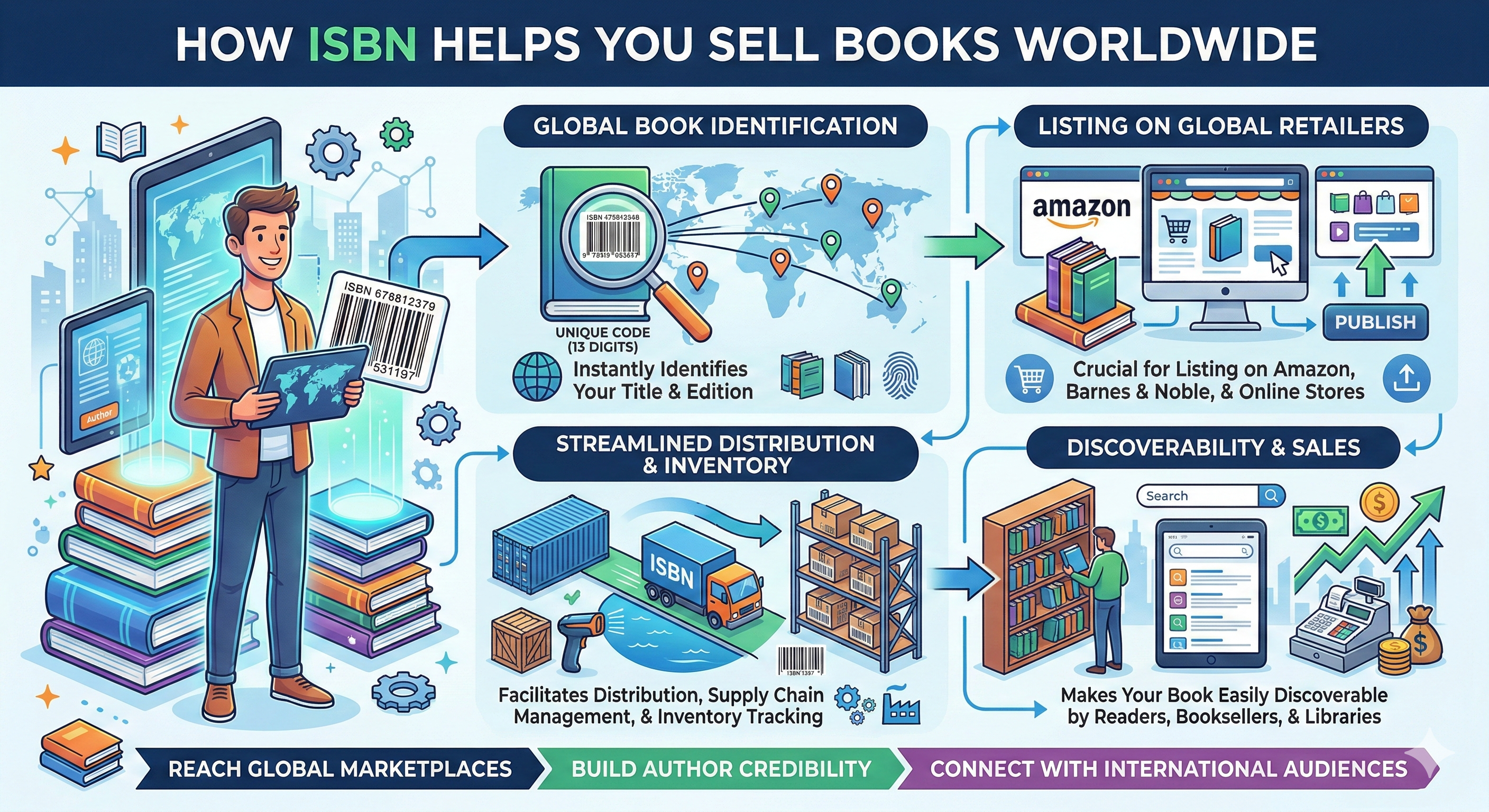
1. Makes Your Book Discoverable
Retailers and libraries search by ISBN.
When your book is in the system:
-
It appears in search results
-
It can be ordered internationally
-
It can be stocked in bookstores
Visibility leads to sales.
2. Enables International Distribution
Global distributors rely on ISBN databases.
If your book has an ISBN:
-
It can enter international supply chains
-
Foreign bookstores can order it
-
Online marketplaces can ship globally
Without it, expansion is limited.
3. Simplifies Inventory Management
Bookstores prefer books that:
-
Have scannable barcodes
-
Are trackable
-
Can be restocked easily
ISBN for book publishing ensures smooth business operations.
4. Helps in Rights and Translation Deals
If your book gains popularity:
-
Foreign publishers may approach you
-
Translation rights may be offered
An ISBN proves your book is officially published and cataloged.
Benefits of ISBN for Book Publishing
Let’s summarize the main benefits.
Wider Market Reach
Your book is not restricted to local sales.
Professional Branding
It builds your image as a serious author.
Accurate Sales Tracking
Sales reports are linked to your ISBN.
Library Inclusion
Libraries require ISBN for cataloging.
Retail Acceptance
Bookstores and distributors prefer standardized products.
Best Practices for Using ISBN Correctly
Getting an ISBN is not enough. You must use it properly.
Use Separate ISBNs for Each Format
Never use one ISBN for multiple versions.
Maintain Accurate Metadata
Incorrect information can:
-
Confuse retailers
-
Reduce discoverability
-
Affect sales
Place Barcode Properly
On printed books:
-
Back cover
-
Clear and scannable
-
Proper size
Keep Records Organized
Maintain:
-
ISBN allocation sheet
-
Format tracking
-
Edition details
This prevents duplication or confusion later.
Common Mistakes Authors Make
Avoid these common errors.
1. Using Free ISBN from Platforms
Some platforms provide free ISBNs.
However:
-
The platform becomes the publisher of record
-
You may face distribution restrictions
Owning your ISBN gives you control.
2. Reusing ISBN for New Edition
If you update content significantly:
-
New edition = New ISBN
Reusing old numbers creates catalog errors.
3. Ignoring Metadata Optimization
ISBN works best when combined with:
-
Strong keywords
-
Clear description
-
Correct categories
4. Incorrect Barcode Placement
Improper barcode size or location may cause scanning failure.
Retailers may reject such copies.
ISBN for Book Publishing and Self-Publishing Success
Self-publishing has opened global opportunities.
But to compete professionally, authors must follow industry standards.
ISBN ensures your self-published book stands equal to traditionally published titles.
It allows:
-
Global listing
-
Wholesale distribution
-
Bulk ordering
-
Institutional sales
If you want long-term success, ISBN is essential.
Why Choose a Professional Publishing Service?
While authors can apply for ISBN themselves, the process can be confusing.
A professional publishing company helps you:
-
Apply correctly
-
Avoid documentation errors
-
Assign ISBN properly
-
Generate compliant barcodes
-
Optimize metadata
-
Manage global distribution
More importantly, professionals ensure your book meets international publishing standards.
This reduces:
-
Rejection risk
-
Listing errors
-
Distribution delays
Working with experts saves time and protects your book’s global potential.
ISBN vs ASIN: What’s the Difference?
Some authors get confused.
ASIN is used by Amazon for internal tracking.
ISBN for book publishing is a universal global standard.
If you rely only on ASIN:
-
Your book stays limited to one platform
If you use ISBN:
-
Your book becomes globally tradable
For serious authors, ISBN is the smarter choice.
Does Every Book Need an ISBN?
In most professional cases, yes.
However:
-
Personal journals not for sale may not need one
-
Private printing may skip ISBN
But if you plan to:
-
Sell online
-
Distribute internationally
-
Approach bookstores
-
Get library listings
Then ISBN for book publishing is required.
Cost vs Value: Is ISBN Worth It?
Some authors hesitate because of cost.
But think long term.
ISBN provides:
-
Lifetime identification
-
Global access
-
Professional positioning
Compared to printing and marketing expenses, ISBN is a small investment with massive returns.
Final Thoughts: ISBN Is the Gateway to Global Book Sales
Writing a book is only the first step.
Selling it worldwide requires structure, standards, and proper registration.
ISBN for book publishing is the foundation of professional distribution.
It gives your book:
-
Identity
-
Credibility
-
Discoverability
-
Global reach
Without it, your book remains limited.
With it, your book can travel across borders, appear in international catalogs, and reach readers around the world.