ISBN for New Authors: Simple Complete Guide
Introduction: Why ISBN Confuses New Authors
If you are publishing your first book, you have probably heard the term ISBN. Many new writers feel confused when they see it during the publishing process.
Questions like these are common:
-
Do I really need an ISBN?
-
How do I get one?
-
Does every format need a different ISBN?
-
What happens if I publish without it?
The good news is this: understanding ISBN for new authors is not difficult. Once you know what it means and how it works, the process becomes simple and clear.
In this complete guide, you will learn what an ISBN is, why it matters, how to get one step-by-step, common mistakes to avoid, and when to use professional publishing support.
Let’s start from the basics.
What Is an ISBN?
ISBN stands for International Standard Book Number. It is a unique 13-digit number assigned to a book.
Think of it like:
-
A fingerprint for your book
-
A product code like items in a supermarket
-
An identity card for your published work
Every published book that is meant for sale usually needs an ISBN.
What Does an ISBN Do?
An ISBN helps:
-
Bookstores identify your book
-
Online platforms list your book
-
Libraries catalog your book
-
Distributors track your book
-
Retailers manage inventory
Without an ISBN, your book may not be easily discoverable or sellable through major channels.
Why ISBN Is Important for New Authors
Understanding the importance of ISBN for new authors is critical before publishing.
1. Makes Your Book Official
An ISBN makes your book a recognized product in the publishing industry. It shows that your book is professionally published.
2. Helps in Distribution
If you want your book to:
-
Be sold in bookstores
-
Be listed on online marketplaces
-
Be available in libraries
You usually need an ISBN.
3. Builds Author Credibility
When readers, bookstores, and distributors see an ISBN, they take your book seriously. It signals professionalism.
4. Tracks Sales and Inventory
ISBN allows retailers and distributors to track:
-
Sales numbers
-
Stock levels
-
Editions
This is very useful for growing authors.
How ISBN Is Structured
An ISBN is a 13-digit number. It looks like this:
978-93-XXXX-XXX-X
It has different parts:
-
Prefix element
-
Registration group
-
Registrant
-
Publication
-
Check digit
You do not need to memorize these parts. But it helps to know that each section has a meaning and is assigned officially.
Do All Books Need an ISBN?
This is one of the most common questions about ISBN for new authors.
You Need an ISBN If:
-
You are publishing a printed book for sale
-
You are distributing through bookstores
-
You are selling on major platforms
-
You want library access
You May Not Need an ISBN If:
-
You are sharing a free PDF only
-
You are printing copies for personal use
-
You are publishing only on a platform that provides its own identifier
However, if you want long-term growth as an author, having your own ISBN is highly recommended.
Does Every Format Need a Separate ISBN?
Yes. This is very important.
Each format of your book needs its own ISBN.
For example:
-
Paperback – 1 ISBN
-
Hardcover – 1 ISBN
-
eBook – 1 ISBN
-
Audiobook – 1 ISBN
Even if the content is the same, each format is treated as a different product.
Many new authors make the mistake of using the same ISBN for multiple formats. This creates serious distribution issues.
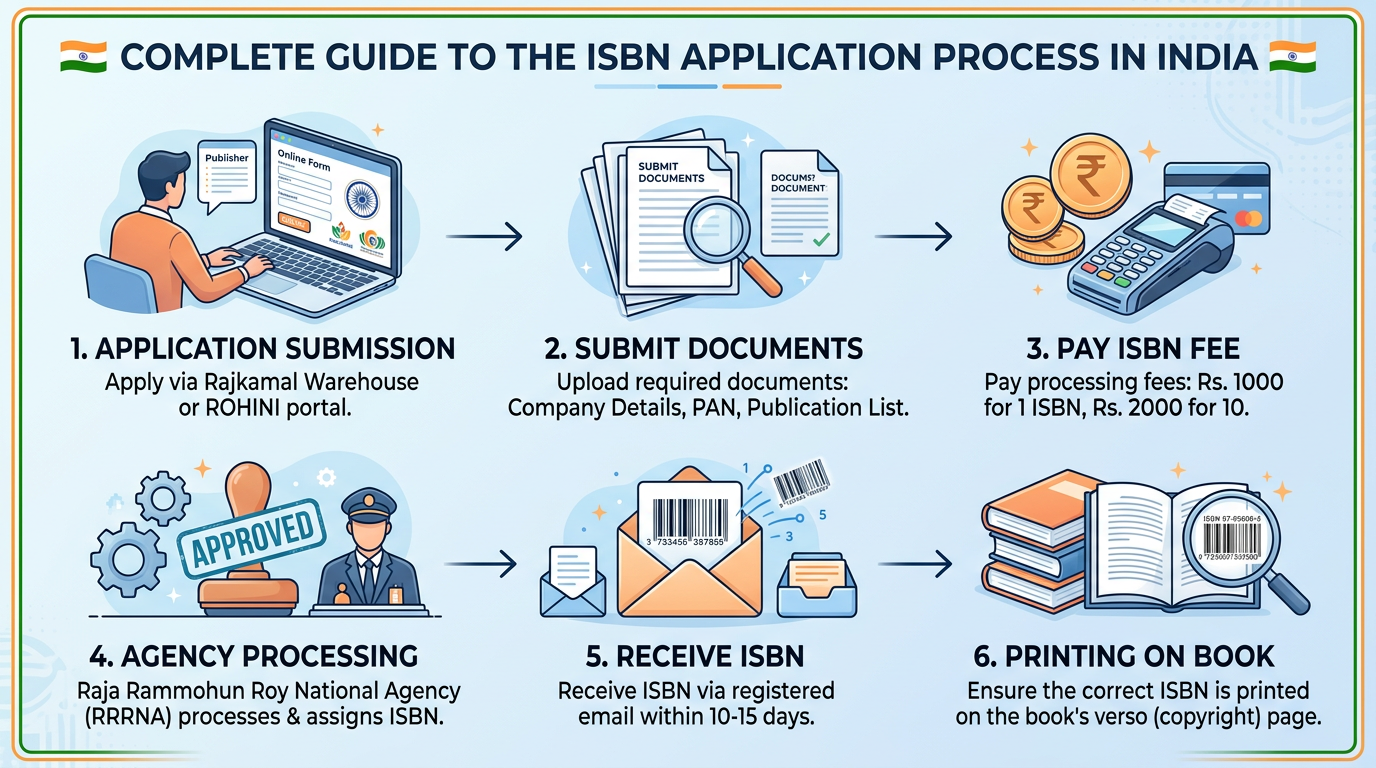
Step-by-Step: How to Get an ISBN
Now let’s understand the process clearly.
Step 1: Decide Your Publishing Method
Are you:
-
Self-publishing independently?
-
Using a publishing company?
-
Publishing through an online platform?
Your method will affect how you get your ISBN.
Step 2: Apply Through the Official Agency
Each country has an official ISBN agency.
In India, ISBNs are issued by the government’s designated authority. The application is usually online and requires:
-
Book title
-
Author name
-
Format details
-
Publisher information
Step 3: Submit Required Documents
You may need:
-
Identity proof
-
Book cover design
-
Copyright page details
-
Publisher information
Always check official guidelines carefully.
Step 4: Wait for Approval
After submission, the authority reviews your application.
Once approved, you receive your unique ISBN number.
Step 5: Add ISBN to Your Book
After receiving the ISBN:
-
Place it on the copyright page
-
Add it to the back cover as a barcode
-
Include it in metadata while uploading to platforms
Where to Place the ISBN in Your Book
Correct placement is important.
Inside the Book
On the copyright page, usually behind the title page.
It should include:
-
ISBN number
-
Edition
-
Year of publication
-
Publisher name
On the Back Cover
The ISBN should be converted into a barcode.
The barcode is scanned at bookstores and warehouses.
Benefits of Owning Your Own ISBN
When understanding ISBN for new authors, it is important to know the difference between:
-
Platform-provided ISBN
-
Author-owned ISBN
Platform-Provided ISBN
Some platforms give you a free ISBN.
Pros:
-
Easy
-
Fast
Cons:
-
The platform becomes the publisher of record
-
Limited flexibility
Author-Owned ISBN
Pros:
-
You remain the publisher
-
Full control
-
Better branding
-
Professional image
For serious authors, owning your ISBN is usually the better long-term choice.
Common Mistakes New Authors Make
Let’s look at errors you must avoid.
1. Using One ISBN for All Formats
As mentioned earlier, each format needs a different ISBN.
2. Publishing Without ISBN
Some authors skip ISBN to save time or effort. Later, they face:
-
Distribution problems
-
Listing issues
-
Sales limitations
3. Incorrect Metadata
Your ISBN is connected to your book details.
If the title, author name, or edition does not match properly, it can create confusion in databases.
4. Placing ISBN Incorrectly
If the barcode is printed poorly or placed wrongly, bookstores may not scan it properly.
5. Not Updating for New Editions
If you make major changes and release a new edition, it needs a new ISBN.
ISBN vs Copyright: What’s the Difference?
Many beginners confuse these two.
ISBN
-
Identifies your book as a product
-
Helps in sales and distribution
Copyright
-
Protects your content legally
-
Protects against copying
Both are important, but they serve different purposes.
ISBN for Self-Publishing Authors
If you are self-publishing, understanding ISBN for new authors becomes even more important.
You are responsible for:
-
Applying for ISBN
-
Adding it correctly
-
Managing metadata
-
Handling distribution
This gives you control but also responsibility.
Best Practices for Using ISBN
Here are some practical tips:
-
Apply early in your publishing timeline
-
Double-check all details before submission
-
Keep records of all ISBN numbers
-
Use a professional barcode generator
-
Ensure print quality is high
Also, always store your ISBN approval documents safely.
When Should You Seek Professional Help?
Getting an ISBN seems simple. However, many authors struggle with technical details.
Professional publishing services can help you with:
-
ISBN application
-
Barcode generation
-
Copyright page formatting
-
Metadata management
-
Distribution setup
This reduces errors and saves time.
Why Choose a Professional Publishing Company?
For new authors, the publishing process can feel overwhelming.
A professional company offers:
1. Accuracy
They ensure all details are correct.
2. Compliance
They follow official guidelines properly.
3. Time-Saving
You focus on writing while they handle technical work.
4. Complete Publishing Support
They assist with:
-
Editing
-
Formatting
-
Cover design
-
ISBN registration
-
Distribution
This creates a smooth and stress-free publishing journey.
Frequently Asked Questions
Is ISBN free?
In some countries, it may be free. In others, it may have a fee.
Can two books have the same ISBN?
No. Each ISBN is unique.
Can I reuse an old ISBN?
No. Once assigned, it stays linked to that specific edition.
Do I need ISBN for an eBook?
Yes, if you want professional distribution beyond a single platform.
Final Thoughts on ISBN for New Authors
Publishing your first book is exciting. However, technical steps like ISBN often create confusion.
Now you understand:
-
What ISBN means
-
Why it is important
-
How to apply
-
Where to place it
-
Common mistakes to avoid
Understanding ISBN for new authors is one of the first professional steps in your publishing journey.
Treat your book like a serious product. Assign it a proper identity. Manage it correctly. And if needed, work with experienced professionals who can guide you smoothly.